what direction is the pacific plate moving
Magma from the mantle pushing up to fill the voids left by divergence of the two plates, Magma cooling more slowly in the lower part of the new crust and forming gabbro bodies, Figure \(\PageIndex{1}\): Plates tect2 en by the. [citation needed], The western side is bounded by the Okhotsk Plate at the KurilKamchatka Trench and the Japan Trench. Pacific plate, Australia plate, Africa plate, Scotia plate, Nazca plate, South America plate. And the plate that Australia sits on has been moving relatively fast, about 2.7 inches a year (northward and with a slight clockwise rotation). This plate includes all of Saudi Arabia, and much of the Levant (up to Iraq and Syria).
By 50 Ma, Australia had separated from Antarctic, and shortly after that, India collided with Asia. For example the Juan de Fuca Plate is actually three separate plates (Gorda, Juan de Fuca, and Explorer) that all move in the same general direction but at slightly different rates. Eurasia plate, Pacific plate. The eastern margins of North and South America and the western margins of Europe and Africa are called passive margins because there is no subduction taking place along them. Dont worry if you cant name them all. The Pacific plate forms a divergent boundary in the See full answer below. 1 )attendant tectonic events along the margins of its neighbouring plates should be expected. A subduction zone offshore of Japan consumes the Pacific plate, which is partly melted to create the volcanoes of Japan. Channel Islands National Park includes five islands that are the tops of a mostly-submerged portion of the Transverse Ranges. Images above modified from Earth: Portrait of a Planet, by S. Marshak, 2001, W. W. Norton & Comp., New York. The long mountain ridges and narrow bays in the region surrounding U. S. Virgin Islands National Park are a product of compression due to the convergence, in addition to lateral motion due to shearing along the transform plate boundary. Remnants of the ancient volcanic mountain chain remain. Shouldnt the line reading While the North American plate in the east moves in the southwest direction read southEAST direction? The compressed and uplifted region includes the Santa Monica Mountains north of Los Angeles as well as the Channel Islands south of Santa Barbara. The cumulative movement within the broad San Andreas transform plate boundary has had dramatic effects on a landscape that initially developed as part of an ocean/continent subduction zone. while the North America is being pushed to the southwest due to the spreading of the seafloor in the mid-Atlantic ridge.  Thousands of earthquakes over millions of years have built this landscape not only along the major fault linethe San Andreas Faultbut also on other faults within the broad zone of shearing between the Pacific and North American plates. The broad zone of transform motion between the Pacific and North American plates formed numerous slivers of mountain ranges with narrow valleys in between. Nazca plate, Pacific plate, North America plate, Caribbean plate. In the Caribbean Sea, the U. S. Virgin Islands lie along a transform plate boundary where the small Caribbean Plate moves eastward past the oceanic part of the North American Plate. Northwest What direction has the Pacific plate been moving for the last 40 million years?
 the Pacific Plate This plate is small.
There is strong evidence around the margins of the Atlantic Ocean that this process has taken place before. This cookie is set by GDPR Cookie Consent plugin. a. Northwest because of the formation of newer islands (g) Assuming that the current direction of motion continues, what will be the eventual fate of the Meiji seamount?  However, you may visit "Cookie Settings" to provide a controlled consent. The broad zone of shearing at a transform plate boundary includes masses of rock displaced tens to hundreds of miles, shallow earthquakes, and a landscape consisting of long ridges separated by narrow valleys. Seafloor topography map source: Global sea floor topography from satellite and ship depth soundings, 1997, by W. H. F. Smith and D. T. Sandwell, Science, v. 277, p. 1956-1962. This plate is moving north east towards the Arabia and Eurasia plates. Photo courtesy of the National Parks Conservation Association. The colliding continental material will not be subducted because it is too light (i.e., because it is composed largely of light continental rocks [SIAL]), but the root of the oceanic plate will eventually break off and sink into the mantle. South America plate, Pacific plate, Antarctic plate, Cocos plate. [2] The plate first came into existence 190 million years ago, at the triple junction between the The Pacific Plate stretches all the way along the west coast of North America up to Alaska. This cookie is set by GDPR Cookie Consent plugin. Already mentioned, the Pacific Ring of Fire has the most active chains of volcanoes in the world. The San Andreas Fault is responsible for most of the movement in western California, causing a sliver of the state to slide past the rest of the continent. The average movement of the Pacific Plate past the North American Plate in California is about 2 inches (5 centimeters) per year. See Appendix 3 for Exercise 10.4 answers. transform plate boundary The transform plate boundary is a broad zone forming as the Pacific Plate slides northwestward past the North American Plate. WebIn what direction is the Pacific Plate moving? The plate motion has changed to northwestward, forming the Hawaiian Ridge and Hawaiian Islands. The southern part of Zealandia, which is to the east of this boundary, is the plate's largest block of continental crust. Remember that the hotspot remains in the same location and the lithosphere moves over it (as shown in the Hot Spot video). As you slide your hands laterally past one another, a broad zone of shearing develops as several card faces slip. WebThe Pacific Plate is moving in the northwest direction at a rate of 56 to 102 millimeter per year. Some transform faults connect continental parts of plates.
Both plates are capped by oceanic crust. Plates move as rigid bodies, so it may seem surprising that the North American Plate can be moving at different rates in different places. National Park Service sites along the transform plate boundary in California contain rocks formed during the earlier subduction that occurred in western North America. The southern edge is a divergent plate boundary with the Antarctic Plate. The part of California west of the San Andreas Fault and all of Baja California are on the Pacific Plate.
Pangea, which existed from about 350 to 200 Ma, was not the first supercontinent. WebThe Pacific Plate is an oceanic tectonic plate that lies beneath the Pacific Ocean. But its an interior hot spot within the Pacific Plate that is responsible for the volcanic activity that occurs here. This is why some of the mountain chains formed during the earlier collision can be traced from Europe to North America and from Europe to Africa. They were lifted out of the ocean as part of the accretionary wedge of an ancient subduction zone. Explain in as much detail as possible. WebAs the plate moves in a northwesterly direction over the stationary hotspot, new volcanoes are formed, while older ones become extinct. Its explanatory gravitas and the weight of observational evidence overcame much initial skepticism over how mobile the Earth's surface really is, and Plate Tectonics quickly became universally accepted by scientists throughout the world. By the end of 1967 the Earths surface had been mapped into a series of plates (Figure \(\PageIndex{1}\)). [3], The north-eastern side is a divergent boundary with the Explorer Plate, the Juan de Fuca Plate and the Gorda Plate forming respectively the Explorer Ridge, the Juan de Fuca Ridge and the Gorda Ridge. Are you interested in learning more about this topic? The new calculations showed the Pacific plate is pulling away from the North American plate a little more approximately 2 millimeters a year than the rigid-plate theory would account for, he said. There are two kinds of plates oceanic and continental plates.
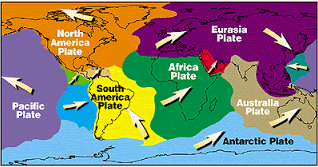 Most of this water is present within the sheet silicate mineral serpentine which is derived from alteration of pyroxene and olivine near the spreading ridge shortly after the rocks formation. WebIt has more radioactivity than in the inner core. Eurasia plate, Pacific plate, Africa plate, Caribbean plate, South America plate, Cocos plate, Juan de Fuca plate. north west Loihi Seamount, an active submarine volcano, is forming Without referring to the plate map in Figure \(\PageIndex{1}\), or any other resources, write in the names of as many of the plates as you can. WebConcept note-1: -The San Andreas Transform Plate Boundary developed within the past 40 million years as a large portion of the Farallon Plate was subducted and the Pacific Plate made contact with the North American Plate in the California region. Presently the Hawaiian Islands and our part of the Pacific plate are moving northwest at about 100 mm (4 in.)
This plate moves north and slightly west towards the Caribbean plate and the North America plate. Plate boundaries from The Plates Project, University of Texas Institute for Geophysics. The North American Plate is being pushed west and north west due to sea floor spreading from the Mid Atlantic Ridge (divergent margin). The Pacific Ocean is the worlds largest ocean. The Transverse Ranges north and east of Los Angeles are so named because they trend in an east-west direction, contrary to the northwest-southeast orientation typical of other ranges along the San Andreas transform plate boundary. WebThe Hawaiian Islands form an archipelago that extends over a vast area of the North Pacific Ocean. Boundaries between the plates are of three types: divergent (i.e., moving apart), convergent (i.e., moving together), and transform (moving side by side). Centralia, Washington, and the Canadia border, The Tsunami At Anaqtla or "Pachena Bay". The Pacific Plate is almost entirely oceanic crust, but it contains some continental crust in New Zealand, Baja California, and coastal California.  This plate is rotating in a clockwise direction towards the Pacific plate. An example is the San Andreas Fault, which extends from the southern end of the Juan de Fuca Ridge to the northern end of the East Pacific Rise (ridge) in the Gulf of California (Figures 10.28 and 10.29). As these two plates pull apart from each other, it forms new oceanic crust. It runs along the west coast of Mexico and western Caribbean countries. Volcanic rocks at Pinnacles National Park were displaced about 190 miles (305 kilometers), while granitic rocks of Point Reyes National Seashore have moved about 310 miles (500 kilometers). Pacific Plate X Photo: NOAA Tracking the Hawaiian Islands: How Fast Does the Pacific Plate Move? NM = National Monument
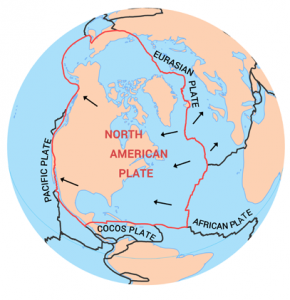 Doing some quick math, one can appreciate how dramatically plate-tectonic forces can affect the landscape, even in our lifetimes. WebAn otherwise inexplicable kink in the chain marks a shift in the movement of the Pacific plate some 47 million years ago, from a northward to a more northwesterly direction, and the kink has been presented in geology texts as an example of how a tectonic plate can shift direction comparatively suddenly. The North American plate is moving to the west-southwest at about 2.3 cm (~1 inch) per year driven by the spreading center that created the Atlantic Ocean, the Mid Atlantic Ridge.
North America plate, South America plate, Cocos plate. Photo by Robert J. Lillie. The largest one, the Pacific Plate is moving north west relative to the plate that holds North America, and relative to hot spots coming up through the mantle from below the plates (they generate islands like Hawaii). Download the official NPS app before your next visit. In California, much of the strain generated by the grinding of the Pacific Plate against North America is taken up in earthquakes on the San Andreas Fault and related structures, but the shearing action doesn'tend there. If spreading along the mid-Atlantic ridge continues to be slower than spreading within the Pacific Ocean, the Atlantic Ocean will start to close up, and eventually (in a 100 million years or more) North and South America will collide with Europe and Africa. At one time, it moved in a mostly northern direction. In the middle of the eastern side is a transform boundary with the North American Plate along the San Andreas Fault, and a boundary with the Cocos Plate. Farther east, the continent began to rift apart in the Basin and Range Province.  At present, North and South America, Europe, and Africa are moving with their respective portions of the Atlantic Ocean. It is suggested that this type of valley eventually develops into a linear sea (such as the present-day Red Sea), and finally into an ocean (such as the Atlantic). Instead, blocks of crust are torn apart in a broad zone of shearing between the two plates. But the Pacific Ocean is slowly shrinking at a rate of 0.5 square kilometers (0.19 square miles) per year due to Plate Tectonics. It has greater water content than the inner core. Virgin Islands National Park in the U. S. Virgin Islands is located on another transform plate boundary, where the Caribbean Plate is sliding past the oceanic part of the North American Plate. When oceanic and continental plates meet, the denser oceanic plate moves under the less dense continental plate. WebOther articles where Antarctic Plate is discussed: Antarctica: Antarctica and continental drift: and jostling of immense crustal plates (see plate tectonics). WebYes at the rate of nearly 47km per million years (f) In what direction is the Pacific Plate moving today? Notice what happens as you move your left hand away and slide your right hand toward you. Once youve named most of the plates, draw arrows to show the general plate motions. The 16 feet (about 200 inches, or 5 meters) of offset along the fence line thus carries a powerful message. This horse-shoe-looking pattern of plate tectonics has some of the most catastrophic earthquakes and volcanoes on Earth. Imagine that your left hand is the undeformed Pacific Plate, your right hand the intact North American Plate. Rates of motions of the major plates range from less than 1 cm/y to over 10 cm/y. It includes many lesser faults in addition to the San Andreas Fault. The Pacific Plate subsequently grew to where it underlies most of the Pacific Ocean basin. Is the Pacific Plate growing or shrinking? The San Andreas Fault Zone is not the only active transform plate boundary with U. S. National Park Service sites. The cookie is used to store the user consent for the cookies in the category "Performance". The San Andreas Fault is the transform plate boundary where a thin sliver of western California, as part of the Pacific Plate, slides north-northwestward past the rest of North America. The cookies is used to store the user consent for the cookies in the category "Necessary". It takes a lot of slip (10s of meters) over a very large area to generate the M9 subduction zone earthquakes that rock our region ~ every 550 years on average. The Pacific Plate At this fault, the Pacific Plate slides past the North American Plate. The granite rocks in the foreground are similar to those found in Yosemite National Park in the Sierra Nevada Mountains. See Appendix 3 for Exercise 10.5 answers. This plate is rotating counter clockwise in towards the Pacific plate. The subducted lithosphere descends into the hot mantle at a relatively shallow angle close to the subduction zone, but at steeper angles farther down (up to about 45). Dr. Ray Wells of the USGS developed a model to demonstrate this process and produced the cartoon animation located above the GPS Vector map.