standard lapse rate calculator
The standard rate of cooling is -3.57 degrees F for every 1,000 feet, up to nearly 36,000 feet (6.8 miles). The lapse rate definition includes wet and dry adiabatic lapse rate, environmental lapse rate, and standard temperature lapse rate. WebCalculates the atmospheric pressure at the present location from the altitude and temperature, and sea-level pressure. The only difference is the exponent in Equation 1. Can You Select a DPE for Your Check Ride? Copyright 2023 Flying Media. A negative lapse rate adds stability that ultimately inhibits vertical mixing. WebThe first equation is applicable to the standard model of the troposphere in which the temperature is assumed to vary with altitude at a lapse rate of ; the second equation is
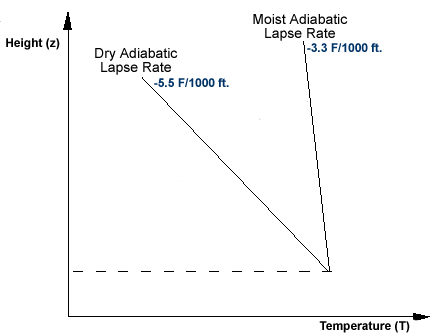
For every 1000 feet change in altitude (both vertical ascent and descent), the wet adiabatic lapse rate is on average -3.3 or 3.3 degrees F, respectively (about -0.5 degrees C per 100 meters). There are two equations for computing density as a function of height. How does latitude affect the air temperature at 8 km altitude where planes fly? The barometric formula can be derived using the ideal gas law: Assuming that all pressure is hydrostatic: Integrating this expression from the surface to the altitude z we get: Assuming linear temperature change Earths AtmosphereDue to the fact that Earths atmosphere experiences different rates of heating and cooling through each of its layers, these equations help to model this through the use of the temperature lapse rate, which is the rate at which temperature changes through altitude change. This allows the flow of air a few hundred feet above the ground to be insulated and decouple from surface friction, allowing the wind immediately above the surface to freely accelerate and create a low-level jet maximum. Many products featured on this site were editorially chosen. The MPM Calculator can output the previous benefit cost (PBC), previous benefit cost ratio There are two equations for computing pressure as a function of height.

Environmental Lapse Rate Overview & Influences | What is Lapse Rate? [Credit: Shutterstock]. WebThis difference is then converted into feet, based on the given that 1Hg = 1000this is referred to as the Standard Pressure Lapse Rate. If the temperature goes above the standard temperature, the air density decreases. A lapse rate is simply the change in temperature over a given change in altitude.
 That means, on an average day, the atmosphere cools at this rate. This difference is then converted into feet, based on the given that 1Hg = 1000this is referred to as the Standard Pressure Lapse Rate.
Flying Magazine is a one-stop resource for everything aviation, including news, training, aircraft, gear, careers, photos, videos, and more. Wet lapse rates measure saturated air parcels and can indicate precipitation or severe weather. Accordingly, if the current altimeter setting is 30.12Hg., we would calculate as follows: 30.12 29.92 = .2. See real gas or perfect gas or gas for further understanding.).
The lapse rate doesnt always hold true. Web= standard temperature lapse rate [K/m] = -0.0065 [K/m] = height about sea level [m] = height at the bottom of atmospheric layer [m] = universal gas constant = 8.31432 = The Lapse Rate is the rate at which temperature changes with height in theAtmosphere. WebThe lapse rate of nonrising aircommonly referred to as the normal, or environmental, lapse rateis highly variable, being affected by radiation, convection, and condensation; it When air is forced to rise up in the atmosphere, the pressure reduces with height. In the overnight hours with clear skies and calm or light winds near the surface, radiative cooling can produce a very pronounced and often shallow temperature inversion hugging the surface. This sets the stage for significant cooling at the ground level to produce a surface-based nocturnal temperature inversion. WebA lapse rate is the rate of temperature change with height. 0 Atmosphere Diagram & Temperature | Layers of Atmosphere Temperature, Mid-Latitude Cyclones Features & Facts | Polar Front Theory of Cyclogenesis, Orographic Lifting | Effect, Precipitation & Concept, The Effects of Semi-Permanent Pressure Cells, Environmental Science 101: Environment and Humanity, SAT Subject Test Chemistry: Practice and Study Guide, Introduction to Earth Science: Certificate Program, Holt McDougal Earth Science: Online Textbook Help, Glencoe Earth Science: Online Textbook Help, Introduction to Human Geography: Help and Review, ILTS Science - Physics (116): Test Practice and Study Guide, ILTS Science - Environmental Science (112): Test Practice and Study Guide, ILTS Science - Chemistry (106): Test Practice and Study Guide, SAT Subject Test Biology: Practice and Study Guide, NY Regents Exam - Earth Science: Test Prep & Practice, UExcel Anatomy & Physiology: Study Guide & Test Prep, Create an account to start this course today. The temperature lapse rate in an atmosphere is the rate of decrease of temperature with height; that is to say, it is dT/dz. The most complex situation is when the troposphere is considered conditionally unstable, since a trigger may be needed to enhance either the stability or instabiliy factor. In saturated parcels, atmospheric water vapor can condense into liquid water. What are the equation linking static air temperature with true airspeed & altitude?
As somewhat unstable air near the surface is forced into this layer of stable air, it expands and becomes cooler and denser than the surrounding air, thanks to the inversion aloft. The distinctions between stability and instability as noted above are the foundation of weather analysis, in particular for afternoon airmass thunderstorm development or stable conditions.
In the troposphere, temperature and pressure decrease as altitude increases, impacting lapse rate. The moist adiabatic lapse rate varies considerably because the amount of water vapour in the air is highly variable. Considering the parcel of air as before and utilizing the DALR and SALR for that parcel of air in contrast to the surrounding air: If the ELR is greater than the DALR, rising air will be warmer than the surrounding air and therefore keep rising; the atmosphere is then said to be unstable. Relative humidity is the amount of water vapor in the parcel compared to the maximum the parcel can hold at a given temperature. The global average lapse rate will be different than a country or region average lapse rate. Check out our Interplanetary Air Pressure at Altitude Calculator. lapse rate, rate of change in temperature observed while moving upward through the Earths atmosphere. The lapse rate is considered positive when the temperature decreases with elevation, zero when the temperature is constant with elevation, and negative when the temperature increases with elevation ( temperature inversion ). The wind at the surface can be calm, but the air at 2,000 feet AGL may be screaming along at 50+ knots. Standard lapse rate = -1" hg. The dry adiabatic lapse rate for air depends only on the specific heat capacity of air at constant pressure and the acceleration due to gravity. Create your account. Scott is the author of "The Skew-T log (p) and Me: A Primer for Pilots" and the founder of EZWxBrief. (For exact results, it should be remembered that atmospheres containing water do not behave as an ideal gas. Wondering what the air pressure is on Jupiter or Mars? Lastly, radiative cooling and a nocturnal temperature inversion can also wreak havoc on ground-based Doppler weather radars, causing an unwelcomed phenomenon called anomalous propagation (AP). At 10,000 feet msl, there will be a standard temperature of -4.8 C or 23.3 F. Keep in mind at sea level, the standard temperature is 15 C or 59 F, Measured at sea level, your standard temperature is 15 C or 59 F and your standard pressure is 29.92 inches of mercury. All other trademarks and copyrights are the property of their respective owners. Our editors will review what youve submitted and determine whether to revise the article. Calculating the standard temperature in aviation is actually an easier process than many beginner pilots may think. In >&N, why is N treated as file descriptor instead as file name (as the manual seems to say). If the ELR is less than the SALR, the air is said to be absolutely stable, since the air, whether saturated or unsaturated, will always be cooler than the surrounding air. You can find up-to-dateflying tips and techniques in FLYING Magazine.
The smaller this percentage, the closer to full credibility. The atmosphere is stable as long as the actual lapse rate is less than the adiabatic lapse rate (which is reduced in humid air) is unstable if the actual lapse rate is greater than the adiabatic lapse rate. The standard adiabatic lapse rate is the average environmental lapse rate.
succeed.
 copyright 2003-2023 Study.com. Air parcels always lower to the dew point temperature, as rising temperatures indicate greater storage capacity and lower relative humidity. Scott resides in Charlotte, North Carolina, and flies regularly throughout the Mid-Atlantic and Southeast U.S. In the dry adiabatic lapse rate, no heat energy occurs from condensation as parcels are not at saturation. Why is my multimeter not measuring current? By clicking Accept all cookies, you agree Stack Exchange can store cookies on your device and disclose information in accordance with our Cookie Policy. Therefore, as the air pressure reduces, so does the temperature.
 The temperature will drop around 2 Celsius (-1.98 to be more precise) for each 1000 feet you climb. A Practitioners Guide to Statistical Mortality Graduation This means that when measuring it at sea level, the atmospheric pressure will force the mercury in a barometric gauge to rise to a height of 29.92 inches. When atmospheric pressure is concerned, its important to know that both your standard temperature and standard pressure will decrease together.
lessons in math, English, science, history, and more. All rights reserved. Take Off. The three main factors that directly affect density altitude are altitude, temperature, and humidity. While the standard temperature and pressure wont change, techniques to keep yourself ahead may. dWs/dT is higher in warm air. WebHaving a lapse in car insurance coverage puts your finances at risk and leads to higher rates.
In general, temperature and pressure decrease as altitude increases. While every effort has been made to follow citation style rules, there may be some discrepancies. If the ELR is less than the DALR, then the rising air will be cooler than the surrounding air and will sink - the atmosphere is said to be stable. She has a Bachelor of Science in Biology and a Master of Education. Radiation fog routinely develops in various regions of the U.S. and Canada throughout the year and can be some of the densest fog you will ever encounter. Calculate Block Fuel based on Altitude, Temp, Taxi Fuel, Time for climb/approach and landing, using wait (bash posix) and fail if one process fails in a script, Fermat's principle and a non-physical conclusion. This nocturnal inversion created a large area of AP with intense reflectivity that is indicative of deep, moist convection. Geostrophic Wind Causes & Coriolis Effect | What is Geostrophic Wind? We can compare this lapse rate for any given day to the "standard" dry and moist lapse rates shown in the table below. This chemical state change releases heat energy as a byproduct. 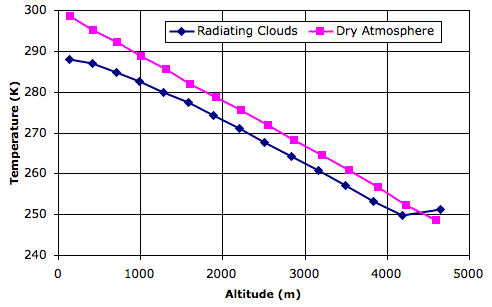

 127 lessons. The MPM Calculator can output the previous benefit cost (PBC), previous benefit cost ratio (PBCR), and other defined metrics. Unstable atmospheric conditions can lead to quick changes in weather such as sudden thunderstorms. The dry lapse rate is a constant. In fact, the air is often glassy smooth in this layer due to the extreme stability courtesy of the surface-based inversion. At 100% relative humidity, parcels reach their saturation point. Then one would interpolate using the forecast winds aloft temperatures. The presence of water vapour in humid air reduces the mean value of (and hence the adiabatic lapse rate), and actual lapse rates are usually rather less than the calculated adiabatic lapse rates even for humid air. Temperature inversions just above the mountain ridges create the opportunity for what meteorologists call gravity waves. Pilots are taught during their primary training that the standard lapse rate is 2 degrees Celsius for every 1,000-foot gain in altitude. The reflected energy follows the same path back to the radar, where it is received and interpreted as a reflectivity value. Because the density of the air will decrease as you gain altitude, the ambient density altitude and pressure altitudes are both important things to consider when flying. As a member, you'll also get unlimited access to over 88,000 The FAA defines density altitude as pressure altitude corrected for nonstandard temperature variations. How did FOCAL convert strings to a number? Inversions are actually quite common in the lower troposphere. For these equations , , and correspond to the altitude, pressure, and temperature at the bottom of the stratosphere. Mid Technology Corporation, founded in 1989, is an Innovative, Agile and Proven engineering company that develops, produces and markets high performance products and solutions.
Even though the returns depicted on this radar image from the Indianapolis NEXRAD Doppler radar look very real, most of them are due to AP. The standard lapse rate can vary depending on the data used in the calculation. 8: Heat Capacity, and the Expansion of Gases, { "8.01:_Heat_Capacity" : "property get [Map MindTouch.Deki.Logic.ExtensionProcessorQueryProvider+<>c__DisplayClass228_0.
As your atmospheric pressure decreases, so will your temperature. This would seem like a classic scenario for clear air turbulence. Values of Pb of b = 1 through b = 6 are obtained from the application of the appropriate member of the pair equations 1 and 2 for the case when h = hb+1.[2]. WebVertical distance above the theoretical plane where atmospheric pressure is equal to 29.92 in. Saturated air is measured using wet adiabatic lapse rate (-3.3 degrees F per 1000 feet).
Interplanetary Air Pressure at Altitude Calculator. If you wish to contribute or participate in the discussions about articles you are invited to join SKYbrary as a registered user. -06C - (2 * 2) = 10C. The International Civil Aviation Organization Standard Atmosphere takes the lapse rate in the troposphere (first 11 km) to be 6.3 K km1. Flying into these waves can be felt as an upwash or downwash, causing the airplane to increase or decrease altitude, respectively. Altitude and temperature are the greatest factors to consider before you fly, but humidity is as well. Nocturnal temperature inversions also create an environment favorable for what meteorologists refer to as non-convective low-level wind shear (LLWS). If you imagine a lump of air to be moved adiabatically to a higher level, its pressure and density will change so that P/ is constant, and it will then find itself in a region where its new density is less that the new ambient density. for each 1000' increase in altitude. pressure altitude corrected for nonstandard temperature variations, From sea level up to 36,000 feet msl, the temperature will likely decrease at a rate of 2 C or 3.5 F for every 1,000 feet gained. In some cases, the temperature may actually increase with increasing altitude. [Credit: Auxins]. As the volume of data increases, the standard deviation of claims as a percentage of total claims will shrink.
Lapse rate is the rate at which temperature changes with altitude, measured in both air parcels and the surrounding air. Lapse rate arises from the word lapse, in the sense of a gradual fall. All rights reserved. Knowing how to properly calculate the standard temperature in aviation can help you keep your plane performing at its best while enjoying every flight. Some layers, such as the stratosphere (from 11km to 20km), have a constant temperature throughout the layer. Sea level standard pressure = 29.92" hg. 
 and constant molar mass and gravitational acceleration, we get the first barometric formula: Instead, assuming constant temperature, integrating gives the second barometric formula: In this formulation, R* is the gas constant, and the term R*T/Mg gives the scale height (approximately equal to 8.4km for the troposphere). The dry adiabatic rate is about -5.5 degree F change in temperature per 1000 feet (-9.8 degrees C per kilometer). -06C for 6000, minus 2000ft/3000ft * 11C = -6C - 7.33C or about -13.3C, In contrast with the standard lapse rate, in this instance the calculation would be: