In late 2016, NOAA and NASA launched the first satellite in the Geostationary Operational Environmental Satellite - R Series. Although the exosphere is technically part of Earth's atmosphere, in many ways it is part of outer space. WebWe humans live in the troposphere, and nearly all weather occurs in this lowest layer. {\displaystyle A}  The altitude of the lower boundary of the exosphere varies. WebWhy are satellites found in the exosphere? These conditions along with other events like bursts of charged particles are called space weather and usually connected to solar activity. Credit: Lockheed Martin Space Systems Corporation. As you can see below, the atmosphere is usually agreed to end at 100 kilometers above sea level. And if those telescopes spot planets out in the galaxy with the same halo that surrounds our Earth, that light could someday be used to locate habitable planets far from our own interstellar front door. Meet 12 Incredible Conservation Heroes Saving Our Wildlife From Extinction, India's Leopard God, Waghoba, Aids Wildlife Conservation In The Country, India's Bishnoi Community Has Fearlessly Protected Nature For Over 500 Years, Wildfires And Habitat Loss Are Killing Jaguars In The Amazon Rainforest, In India's Sundarbans: Where People Live Face-To-Face With Wild Tigers, Africa's "Thunderbird" Is At Risk Of Extinction.
 Click here to download this video (1920x1080, 108 MB, video/mp4).

Vicky Stein However, some of the faster-moving particles don't return to Earth - they fly off into space instead! The exosphere has gases like hydrogen and helium, but they are very spread out. A Satellites in this region, however, do not suffer from heat damage due to the low pressure experienced in the region. That means these satellites can be affected by the constantly changing conditions in the ionosphere including sudden swells of charged particles that increase drag on satellites and shorten their orbital lifetimes, or how long they can continue orbiting Earth. This orbit allows the GOES-R series satellites to constantly scan the earth for severe weather as it develops while also monitoring the sun. Exoplanets orbit stars other than our own sun. The most common molecules within Earth's exosphere are those of the lightest atmospheric gases. Exosphere: The outermost layer of the atmosphere is known as the exosphere. WebAnswer (1 of 7): Let's ask Wikipedia. The ionosphere and aurora as seen from the International Space Station. With Igor Baliukin, a physicist at Russias Space Research Institute and the studys lead author, Bertaux delved back into images of the Earth taken by SWAN in 1996, 1997 and 1998. The thermosphere lies between the exosphere and the mesosphere.  It happens when atoms and molecules in the upper atmosphere, excited by sunlight, emit light to shed their excess energy. This research, Immel said, is a reminder that we dont know everything about our atmosphere. Gas atoms and molecules in the exosphere move along "ballistic trajectories", reminiscent of the arcing flight of a thrown ball (or shot cannonball!) Airglow isn't just a beautiful sight: It's a useful marker for what happens in the ionosphere.
 Satellites have different orbits because their orbits depend on what each satellite is designed to accomplish. Variations in the amount of energy coming from the Sun exert a powerful influence on both the height of the top of this layer and the temperature within it. [4] Here, molecules are ejected on elliptic trajectories until they collide with the surface. Back in the 1990s, Bertaux directed SWANs original and primary mission: to monitor solar wind, a constant barrage of charged particles flowing out of the sun. It does mean, however, that humankind has yet to leave the Earths atmosphere. The hydrogen in our atmosphere is the result of hydrogen atoms separating from water. Satellites are also used to study celestial bodies in space. The bottom of the exosphere is sometimes also referred to as the exobase. Satellites have different orbits because their orbits depend on what each satellite is designed to accomplish. This layer of Earths atmosphere is about 319 miles (513 kilometers) thick. The Earths extended atmosphere isnt much good for supporting life, but it does have consequences for our search for extraterrestrials, said Thomas J. Immel, a physicist at the University of California, Berkeleys Space Sciences Laboratory who was not involved in this study. Most clouds appear here, mainly because 99% of the water vapor in the atmosphere is found in the troposphere. Thats because of gravitythe same force that holds us on Earth and keeps us all from floating away. Gravity is stronger the closer you are to Earth. Satellites are If you throw a ball into the air, the ball comes right back down. The Earth is curving away while both the rocket and the satellite fall around the Earth. That means that to get to outer space, you have to be really far from Earth. Atmospheric temperature becomes nearly a constant above this altitude.
They usually cost millions or billions of dollars, which means none of us will ever own one personally. The moon, the farthest point ever reached by astronauts, orbits well within the geocorona. To get into orbit, satellites first have to launch on a rocket.
And the mission just sent back its first science images! Low earth means below 2000 kilometers. Because the ionosphere is made up of charged particles, it's uniquely reactive to the changing magnetic and electric conditions in space. They usually cost millions or billions of dollars, which means none of us will ever own one personally. Thats fast enough to overcome the strong pull of gravity and leave Earths atmosphere. How does the Hubble Space Telescope affect society?  All Rights Reserved. The exosphere: the uppermost part of the atmosphere The combination of the fast speed and the rotating Earth will make it possible for JPSS satellites to see the weather around our planet every day. And so on. The exobase can be defined in one of two ways: If we define the exobase as the height at which upward-traveling molecules experience one collision on average, then at this position the mean free path of a molecule is equal to one pressure scale height. How is the Hubble Telescope able to see such long distances? Unlike the troposphere, the stratosphere actually gets warmer the higher you go! You see, even when a satellite is thousands of miles away, Earths gravity is still tugging on it. The thermosphere is located above the mesosphere and below the exosphere. More than two decades ago, a spacecraft called SOHO the Solar and Heliospheric Observatory was suspended halfway between the Earth and the sun, searching the sky for a particular frequency of ultraviolet light known as Lyman-alpha radiation. This special, high Earth orbit is called geosynchronous. l Each has served a different purpose, from complex space stations like the International Space Station to the Global Positioning System. In both cases, changes in the ionosphere's density and composition can disrupt these signals. There is a lot of empty space in between. Satellites are, to some degree, "mysterious" objects. Once the rocket reaches the right location above Earth, it lets go of the satellite. Any spacecraft traveling through it wouldnt notice a thing or be slowed by drag. The answer: they both can be used to monitor weather, climate, and the environment. A small portion of our atmosphere "leaks" away into space each year in this way. Low earth satellites orbit above exosphere which is above 400 KM above Earth. On the other hand, NOAAs GOES-East satellite orbits 22,000 miles above Earth. Some of those exoplanets likely fall in the habitable zone, where liquid water might exist on a planets surface. This region does not have a distinct upper boundary as molecules float freely in the layer. JPSS-1. Some can last decades without the need for adjustment. Air pressure drops, and temperatures get colder, as A rocket can go 25,000 miles per hour! Low earth means below 2000 kilometers. For an ideal gas, the number of molecules contained in it is: where If you were to hang out in the thermosphere, though, you would be very cold because there arent enough gas molecules to transfer the heat to you. Bertaux is now at least nominally retired, but in his free time, his attention floats back to some of the long-overlooked, side-project data he collected in his 55-year career.
Together, GOLD and ICON will help us learn a lot more about the ionosphere, this part of space that is closest to home. EXCELENTE OPORTUNIDAD DEPARTAMENTO CNTRICO EN COSQUIN, OPORTUNIDAD CHALET VILLA MIRADOR DEL LAGO. The report concludes that the edges of the atmosphere actually extend more than 391,000 miles from the planets surface, about twice as far as our moon. Many satellites actually orbit Earth within the thermosphere! The yellow areas shows what part of Earth each satellite 'sees' during its orbit. Mercury, the Moon, Ceres, Europa, and Ganymede have surface boundary exospheres, which are exospheres without a denser atmosphere underneath. Each has served a different purpose, from complex space stations like the International Space Station to the Global Positioning System. Image courtesy of NASA. As you can see below, the atmosphere is usually agreed to end at 100 kilometers above sea level. Satellites need to be very far away from earth and above the equator to rotate in this kind of orbit. It has to travel at 17,000 miles per hour to stay in orbit. To put that in context, there are currently only 7,200 functioning satellites floating above the Earth. Layers of the atmosphere: troposphere, stratosphere, mesosphere and thermosphere. See all questions in Rockets, Satellites, and Spaceships. In recent years experts have raised the alarm over increasingly crowded orbits. The moon, the farthest point ever reached by astronauts, orbits well within the geocorona. They travel in space, which feels like an exotic place because most of us have never been there. A rocket can go 25,000 miles per hour! However, the air in this layer is so thin that it would feel freezing cold to us! How long would it take a space probe to reach the farthest star in our solar system? Video showing the difference between a geostationary orbit and a polar orbit. Space weather, in turn, can affect cellphones, GPS maps and electric infrastructure. At this distance, radiation pressure from sunlight exerts more force on hydrogen atoms than does the pull of Earth's gravity. {\displaystyle R} Starting at ground level, it extends upward to about 10 km (6.2 miles or about 33,000 feet) above sea level. The thermosphere is found at distances of between 53 miles to 400 miles from the surface of the Earth. WebWhy are satellites found in the exosphere? It does mean, however, that humankind has yet to leave the Earths atmosphere. Since the exosphere gradually fades into outer space, there is no clear upper boundary of this layer. How does the Hubble Space Telescope take pictures?
 Air pressure drops, and temperatures get colder, as When the Sun is active around the peak of the sunspot cycle, X-rays and ultraviolet radiation from the Sun heat and "puff up" the thermosphere - raising the altitude of the thermopause to heights around 1,000 km (620 miles) above Earth's surface. Phil Davis & Steve Carney This doesnt mean you can go moonwalking without a spacesuit, said Jean-Loup Bertaux, a study coauthor and planetologist. WebAlthough the atmosphere is very, very thin in the thermosphere and exosphere, there is still enough air to cause a slight amount of drag force on satellites that orbit within these layers. WebExosphere starts at a distance of 311 to 621 miles from the earths surface and ends approximately at 6200 miles away from the earths surface. There is It only has to travel about 6,700 miles per hour to overcome gravity and stay in orbit. This means they can collect massive amounts of data quickly compared to alternative instruments on the Earth's surface. is the mean molecular mass of the gas. And satellites that orbit close to Earth must travel at very high speeds to stay in orbit.
The exosphere (Ancient Greek: x "outside, external, beyond", Ancient Greek: sphara "sphere") is a thin, atmosphere-like volume surrounding a planet or natural satellite where molecules are gravitationally bound to that body, but where the density is so low that the molecules are essentially collision-less. The exosphere gradually fades away into the realm of interplanetary space. This layer of Earths atmosphere is about 319 miles (513 kilometers) thick. The coldest temperatures in Earth's atmosphere, about -90 C (-130 F), are found near the top of this layer.
Because it can be hard to define the boundary between the exosphere and outer space (see "Upper boundary of Earth" at the end of this section), the exosphere may be considered a part of the interplanetary medium or outer space. 1 Lyman-alpha lies in the far ultraviolet portion of the light spectrum, where human eyes cant see it. This layer of Earths atmosphere is about 319 miles (513 kilometers) thick. The electrically charged atoms and molecules that are formed in this way are called ions, giving the ionosphere its name and endowing this region with some special properties. WebExosphere starts at a distance of 311 to 621 miles from the earths surface and ends approximately at 6200 miles away from the earths surface. Most clouds appear here, mainly because 99% of the water vapor in the atmosphere is found in the troposphere. This is called a geosynchronous orbit. and temperature Since the launch of Sputnik in the 1950s, thousands of satellites have been put into orbit around the Earth and even other planets. Wouldnt it just fly off in a straight line out into space? Subscribe to Heres the Deal, our politics Instruments used for research purposes are also found in this orbital range so that they are better able to monitor events on Earth. Video showing the difference between a geostationary orbit and a polar orbit. Every orbit of up to 2000 kilometers is defined as LEO and hardly desirable (see below) Satellite Altitude classifications[edit] * That means they require thrusters to keep them in orbit. Satellites can stay in an orbit for hundreds of years like this, so we dont have to worry about them falling down to Earth. But there are also more unpredictable changes, caused by factors both from Earth below and space above, that make it hard to know exactly what the ionosphere will be like at a given time. The infamous ozone layer is found within the stratosphere. Even though the thermosphere is the second-highest layer of Earths atmosphere, satellites that operate here are in low-Earth orbit . Exosphere The fluctuating area between the thermosphere and the exosphere is called the turbopause. There is The Earths atmosphere is described as a fragile coat wrapping around the planet, comparable in scale to an apples skin protecting the fruit. In 2009, communication satellites belonging to Russia and the United States accidentally collided making it the first recorded crash between artificial satellites. That means these satellites can be affected by the constantly changing conditions in the ionosphere including sudden swells of charged particles that increase drag on satellites and shorten their orbital lifetimes, or how long they can continue orbiting Earth. For example, the average altitude of the ISS is about 330 km (205 miles), placing it in the thermosphere below the exosphere! But what if you want to see as much of the world as possible? Although the existence of the geocorona was well-known even in the early 1960s, according to Bertaux, experts at the time would have estimated that it ended well inside of the lunar orbit. Image courtesy of ESA, text enlarged by NewsHour. SATELLITES: Most satellites orbit in the exosphere. Communication and weather satellites are found on higher orbital ranges as they require more expansive views and access to large areas of the Earth at any given time. Science Writers: The United Nations maintains a register of objects found in outer space.
 {\displaystyle l} WebWe humans live in the troposphere, and nearly all weather occurs in this lowest layer. The upper boundary of the exosphere can be defined as the distance at which the influence of solar radiation pressure on atomic hydrogen exceeds that of Earth's gravitational pull. This would make it easier to scan the cosmos. How does the Hubble Telescope see back in time? When the Sun is less active during the low point of the sunspot cycle, solar radiation is less intense and the thermopause recedes to within about 500 km (310 miles) of Earth's surface. The exosphere has gases like hydrogen and helium, but they are very spread out. Air pressure drops, and temperatures get colder, as you climb higher in the troposphere. Satellites in this layer can remain in their orbits for a very long time. Today, one estimate lists nearly 4,000 confirmed and recorded exoplanets, with many more yet to be identified. And so on. A rocket can go 25,000 miles per hour!
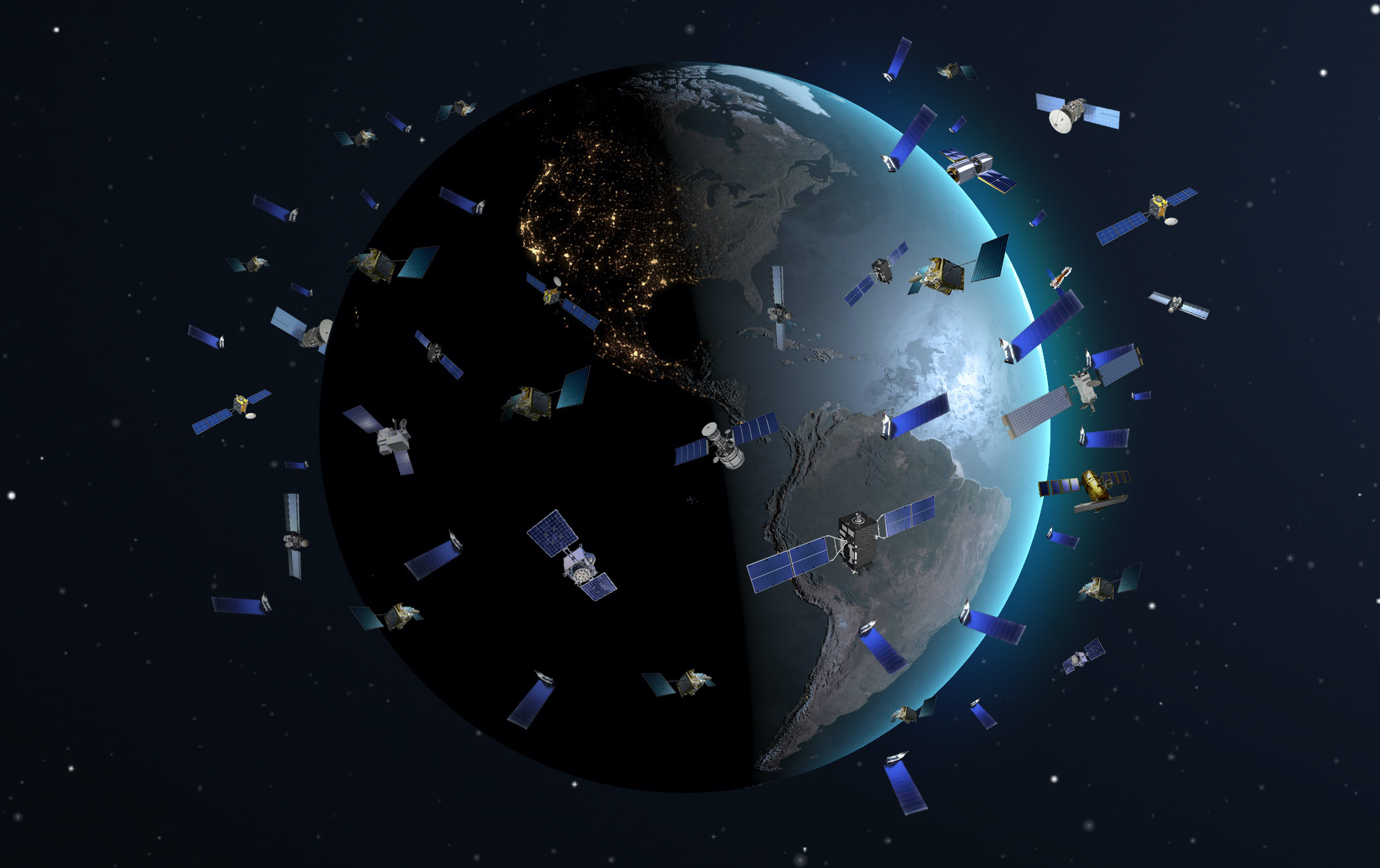
The layer of very rare air above the mesosphere is called the thermosphere. If you were to hang out in the thermosphere, though, you would be very cold because there arent enough gas molecules to transfer the heat to you. Imagine two satellites.  And so on. WebAnswer (1 of 7): Let's ask Wikipedia. Left: Bertaux, Baliukin and their team found the geocorona extends more than 50 times the Earths diameter away from the planets surface. [7], If the atmosphere of a celestial body is very tenuous, like the atmosphere of the Moon or that of Mercury, the whole atmosphere is considered exosphere.[8]. WebBecause the satellite orbits at the same speed that the Earth is turning, the satellite seems to stay in place over a single longitude, though it may drift north to south. [5] On Earth, the altitude of the exobase ranges from about 500 to 1,000 kilometres (310 to 620mi) depending on solar activity.[6]. The geosynchronous orbit is found at the higher levels of the high Earth orbit. Thats fast enough to overcome the strong pull of gravity and leave Earths atmosphere. To get into orbit, satellites first have to launch on a rocket. The ionosphere also plays a role in our everyday communications and navigation systems. The lowest level of the exosphere is called the exobase. This layer of Earths atmosphere is about 319 miles (513 kilometers) thick. Thats because of gravitythe same force that holds us on Earth and keeps us all from floating away. Theres a lot going on in the thermosphere! R beyond the denser, surface-level air that we breathe, can affect cellphones, GPS maps and electric infrastructure. Earth's atmosphere has a series of layers, each with its own specific traits. This is also where youll find low Earth orbit satellites.
 The exosphere extends up to 6,200 miles above the surface of the Earth. There are thousands of satellites orbiting Earth right now. The exosphere, observable from space as the geocorona, is seen to extend to at least 10,000 kilometres (6,200mi) from Earth's surface. To put that in context, there are currently only 7,200 functioning satellites floating above the Earth. Imagine two satellites. WebBecause it can be hard to define the boundary between the exosphere and outer space (see "Upper boundary of Earth" at the end of this section), the exosphere may be considered a part of the interplanetary medium or outer space. This also means there arent enough molecules for sound waves to travel through. ICON studies the ionosphere using a combination of airglow, invisible wavelengths of light, and direct measurements of its surrounding particles. WebBecause it can be hard to define the boundary between the exosphere and outer space (see "Upper boundary of Earth" at the end of this section), the exosphere may be considered a part of the interplanetary medium or outer space. Thats fast enough to overcome the strong pull of gravity and leave Earths atmosphere. Since launching of the Sputnik Satellite into orbit by the Soviet Union, thousands of satellites have been put into orbit by various entities including communication companies and the military.
A Since the launch of Sputnik in the 1950s, thousands of satellites have been put into orbit around the Earth and even other planets. ( Were more interested in the upper atmosphere of planets these days because of exoplanets, Immel said. This boundary to space is right where many of our Earth-orbiting satellites hang out, including the International Space Station. WebWe humans live in the troposphere, and nearly all weather occurs in this lowest layer. WebBecause it can be hard to define the boundary between the exosphere and outer space (see "Upper boundary of Earth" at the end of this section), the exosphere may be considered a part of the interplanetary medium or outer space. newsletter for analysis you wont find anywhereelse. Please check your inbox to confirm. The height of the exosphere is between 700 and 10,000 km from the earth's surface. Any opinions, findings and conclusions or recommendations expressed in this material do not necessarily reflect the views of the National Science Foundation. Solving these two equations gives: which is the equation for the pressure scale height. Credit: NASA/Christina Koch, This site is maintained by the Planetary Science Communications team at.  E This is shown in the following. The layer directly below the exosphere is the thermosphere; the boundary between the two is called the thermopause.
As you can see below, the atmosphere is usually agreed to end at 100 kilometers above sea level. Commercial passenger jets fly in the lower stratosphere, partly because this less-turbulent layer provides a smoother ride. Unlike the stratosphere, temperatures once again grow colder as you rise up through the mesosphere. They usually cost millions or billions of dollars, which means none of us will ever own one personally. This also means there arent enough molecules for sound waves to travel through. It has high temperatures reaching up to 2,730 degrees Fahrenheit. Photo courtesy of NASA. The outer space refers to the expanse found beyond the Earths atmosphere between celestial bodies. Satellites allow access or a view of large areas of the Earth's surface at any given time. WebAnswer (1 of 7): Let's ask Wikipedia. Moving upward from ground level, these layers are called the troposphere, stratosphere, mesosphere, thermosphere, and exosphere. Along with regular weather from here on Earth, space weather is the other major factor that impacts the ionosphere. Lyman-alpha is, basically, the color of hydrogen, Bertaux said. Design & Development: WebBecause the satellite orbits at the same speed that the Earth is turning, the satellite seems to stay in place over a single longitude, though it may drift north to south. Satellites dont fall from the sky because they are orbiting Earth. The yellow areas shows what part of Earth each satellite 'sees' during its orbit. These satellites let Earth do the hard work.