np.where() returns the index of the element that satisfies the condition. If you want to extract elements that meet the condition, you can use ndarray[conditional expression]. Plagiarism flag and moderator tooling has launched to Stack Overflow! When we use the axis parameter, we are specifying which axis we want to summarize. See also the following article for np.delete(). Sometimes, we dont want that.
The NumPy mean function summarizes data. Well also use the reshape method to reshape the array into a 2-dimensional array object. specified in the tuple instead of a single axis or all the axes as Additionally, if youre still a little confused about them, you should read our tutorial that explains how to think about NumPy axes. This method is available in the NumPy module package for calculating the nth discrete difference along the given axis. If the accumulator is too small, overflow occurs: You can also start the sum with a value other than zero: Mathematical functions with automatic domain. Required fields are marked *. Here is the execution of the following given code, Lets have a look at the syntax and understand the working of numpy.subtract() function, Lets take the example of numpy.subtract() function and check how it works. numpy.sum (arr, axis, dtype, out) : This function returns the sum of array elements over the specified axis. Results : Arithmetic mean of the array (a scalar value if axis is none) or array with mean values along specified axis. Choose the correct answer from below list (1)True (2)False Answer:- (1)True 0 Other Important Questions The Central Limit Theorem states that as the sample size gets larger, the sampling distribution of the sample means approaches a normal distribution. But what if you want to specify another data type for the output? np.sign(a) * (np.abs(a)) ** (1 / 3) Categories python Tags numpy, python.
How to Find Index of Value in NumPy Array, How to Use Print Preview in VBA (With Examples), How to Print to PDF Using VBA (With Example), How to Clear Filters in Excel Using VBA (With Example). If axis is a tuple of ints, a sum is performed on all of the axes
NumPy: Select indices satisfying multiple conditions in a NumPy array Last update on August 19 2022 21:51:45 (UTC/GMT +8 hours) NumPy: Array Object Exercise-92 with Solution Write a NumPy program to select indices satisfying multiple conditions in a NumPy array.
And one of the primary toolkits for manipulating data in Python is the NumPy module. This is equivalent to deleting elements, rows, or columns that satisfy the condition.
The & operator can be used as a shorthand for np.logical_and on  Just understand that when you need to dimensions of the output to be the same, you can force this behavior by setting keepdims = True. After that, we have used an np.datetime64() function and pass the array as an argument. the same shape as the expected output, but the type of the output If fed into speedsNp, it yields only the corresponding values of speedNp where the value of the boolean array is True. A tuple (possible only as a So another way to think of this is that the axis parameter enables you to calculate the mean of the rows or columns. Remember, this is a 2-dimensional object, which we saw by examining the ndim attribute. We can also select items based on either condition being met, using the | operator. Arithmetic is modular when using integer types, and no error is Simple examples are also things that you can practice and memorize. An axis is like a dimension along a NumPy array. Lets take a look at a visual representation of this. Here, were working with a 2-dimensional array, but the mean() function has still produced a single value. acknowledge that you have read and understood our, Data Structure & Algorithm Classes (Live), Data Structure & Algorithm-Self Paced(C++/JAVA), Full Stack Development with React & Node JS(Live), Android App Development with Kotlin(Live), Python Backend Development with Django(Live), DevOps Engineering - Planning to Production, GATE CS Original Papers and Official Keys, ISRO CS Original Papers and Official Keys, ISRO CS Syllabus for Scientist/Engineer Exam, stdev() method in Python statistics module, Python | Check if two lists are identical, Python | Check if all elements in a list are identical, Python | Check if all elements in a List are same, Adding new column to existing DataFrame in Pandas, How to get column names in Pandas dataframe. Syntactically, the numpy.mean function is fairly simple. Parameters : arr : This is relevant to the keepdims parameter, so bear with me as we take a look at another example. Remember, if we use np.mean and set axis = 0, it will produce an array of means.
 (I actually had this same problem earlier today, unrelatedly). A location into which the result is stored. in the result as dimensions with size one. The array must have the same dimensions as expected output.dtype : [data-type, optional]Type we desire while computing mean. Syntax: Lets have a look at the syntax and understand the working of numpy.diff () method At least one element satisfies the condition: Delete elements, rows, and columns that satisfy the conditions. When we set axis = 1, we are indicating that we want NumPy to operate along this direction. You can use the following methods to use the NumPy, The following code shows how to select every value in a NumPy array that is less than 5, #select values that meet one of two conditions, Notice that four values in the NumPy array were less than 5, #find number of values that are less than 5 or greater than 20, The following code shows how to select every value in a NumPy array that is greater than 5, The output array shows the seven values in the original NumPy array that were greater than 5, #find number of values that are greater than 5 and less than 20, How to Keep Certain Columns in Pandas (With Examples), How to Fix: Typeerror: expected string or bytes-like object. The above program uses a numpy library and then instead of the n argument, we can perform the axis operation in numpy.diff() function. Numpy does not seem to allow fractional powers of negative numbers, even if the power would not result in a complex number. The keepdims parameter of NumPy mean enables you to control the dimensions of the output. Theres the name of the function np.mean() and then several parameters inside of the function that enable you to control it. If you select a data type with low precision (like int), the result may be inaccurate or imprecise. This function is capable of returning the condition number using If the values in the input array are floats, then the output will be the same type of float.
Said differently, we are specifying which axis we want to collapse. The same is true for the following examples.
Affordable solution to train a team and make them project ready. Now lets take a look at the number of dimensions of the output of np.mean() when we use it on np_array_1d. If not provided or None, the root-of-sum-of-squares norm. For example suppose we have an array that contains some numbers and now we want to subtract with another array and it will return some negative, positive values. In this section, youll learn how to use the np.where() function to process items in a NumPy array. Lets take a look at the syntax of the np.where() function: The syntax of the function can be a bit confusing. 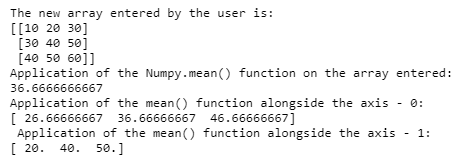 This doesnt have to be the case! Alternative output array in which to place the result. In this section, we will discuss how to find a set difference between two arrays in NumPy Python. WebMean, Median, and Mode: Mean - The average value Median - The mid point value Mode - The most common value By specifying the column axis ( axis='columns' ), the mean () method searches column-wise and returns the mean value for each row. By using the reshape() function, these values have been re-arranged into an array with 2 rows and 3 columns. Any masked values of a or condition are also masked in the output.
On the other hand, if we set keepdims = True, this will cause the number of dimensions of the output to be exactly the same as the dimensions of the input. The sum of an empty array is the neutral element 0: For floating point numbers the numerical precision of sum (and Python numpy difference between two arrays, Python numpy difference between two lists, Matplotlib set_xticks Detailed tutorial, Scikit-learn Vs Tensorflow Detailed Comparison, Drop non-numeric columns from pandas DataFrame, How to get index of rows in Pandas DataFrame, How to drop rows with NaN or missing values in Pandas DataFrame, Pandas add a new column to an existing DataFrame, In this section, we will discuss how to find the difference in, To perform this particular task we are going to use the. Lets quickly examine the contents of the array by using the print() function.
is used while if a is unsigned then an unsigned integer of the In contrast to NumPy, Pythons math.fsum function uses a slower but Once you will print result then the output will display the array 1 elements [14,15,34,42] which are not in array2. When axis is given, it will depend on which axis is summed.
This is a scalar if both x1 and x2 are scalars. #Select elements from Numpy Array which are greater than 5 and less than 20 Now that weve taken a look at the syntax and the parameters of the NumPy mean function, lets look at some examples of how to use the NumPy mean function to calculate averages. any (): return s [positives].mean () else : return 0. Still not convinced that numpy is a good tool for this particular problem, unless there are a huge number of speeds :). Remember, axis 0 is the row axis, so this means that we want to collapse or summarize the rows, but keep the columns intact. If you want to master data science fast, sign up for our email list. axis (optional) Technically, the axis is the dimension on which you perform the calculation. It will therefore compute the mean of the values along that direction (axis 1), and produce an array that contains those mean values: [4., 16.]. Lets take an example and check how to get the difference in NumPy array in Python. WebA common use for nonzero is to find the indices of an array, where a condition is True. If you specify the parameter axis, it returns True if at least one element is True for each axis.  Axis or axes along which a sum is performed. In the case of a two-dimensional array, the result is for columns when axis=0 and for rows when axis=1.
of x1 and x2; the shape is determined by broadcasting. axis removed. By setting keepdims = True, we will cause the NumPy mean function to produce an output that keeps the dimensions of the output the same as the dimensions of the input.
In Cartesian coordinates, you can move in different directions. Return the array to mask as an array masked where condition is True. This will be important to understand when we start using the keepdims parameter later in this tutorial. Input arrays. Order of the norm used in the condition number computation: inf means the numpy.inf object, and the Frobenius norm is Connect and share knowledge within a single location that is structured and easy to search. These are similar in that they compute summary statistics on NumPy arrays.  The matrix whose condition number is sought. Comment * document.getElementById("comment").setAttribute( "id", "ad454e9971b01f88ca020533d62c4ab3" );document.getElementById("e0c06578eb").setAttribute( "id", "comment" ); Save my name, email, and website in this browser for the next time I comment.
 Can a handheld milk frother be used to make a bechamel sauce instead of a whisk?
 Finally, you learned how to use the function to return the indices of an array that meet a condition. If the data is already a numpy array (which uses.
It contains well written, well thought and well explained computer science and programming articles, quizzes and practice/competitive programming/company interview Questions. Theres not really a great way to learn this, so I recommend that you just memorize it the row-direction is axis 0 and the column direction is axis 1. Once again, were going to operate on our NumPy array np_array_2x3.
If you need the output of np.mean to have high precision, you need to be sure to select a data type with high precision. @JoeKington Thanks Joe, I was wondering about some initial overhead for numpy. Explanation: speedsNp > 0 c  import numpy as np #define NumPy array of values x = np.array( [1, 3, 3, 6, 7, 9, 12, 13, 15, 18, 20, 22]) #select values that meet two conditions x [np.where( (x > 5) & (x < 20))] array ( [6, 7, 9, 12, 13, 15, 18]) The output array shows the seven values in the original NumPy array that were greater than 5 and less than 20. If the default value is passed, then keepdims will not be boolean ndarrays. Recall earlier in this tutorial, I explained that NumPy arrays have what we call axes. The default, To see this, lets take a look first at the dimensions of the input array. This is a very clean solution.
 Academic Press, Inc., 1980, pg. If the input is a data type with relatively lower precision (like float16 or float32) the output may be inaccurate due to the lower precision. Having explained axes again, lets take a look at how we can use this information in conjunction with the axis parameter. In Python, this function is available in the NumPy package module and returns the arithmetic value of the array elements. To make this happen, we need to use the keepdims parameter.
Parameters : arr : input array. To subscribe to this RSS feed, copy and paste this URL into your RSS reader.
 As you can see in the Screenshot the output displays the 2.625 as a mean value.

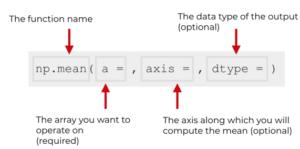
ar1: This parameter indicates the input array. We can use the np.where() function to return an array of the areas, as shown below: In the example above, we worked with two arrays: one containing information on the shape of an object and another containing some dimensions about that object. Rows and columns are extracted by giving each result to [rows, :] or [:, columns]. In this tutorial, youll learn how to use the NumPy where() function to process or return elements based on a single condition or multiple conditions.
np.mean(np_array_3x2) ..there is a little typo (32) ,it should be (23), Why Python is better than R for data science, The five modules that you need to master, The 2 skills you should focus on first, The real prerequisite for machine learning. Now, lets once again examine the dimensions of the np.mean function when we calculate with axis = 0.  In this case, the output of np.mean has a different number of dimensions than the input. Remember, axis 0 is the row axis. Specifically, in a 2-dimensional array, axis 0 is the direction that points vertically down the rows and axis 1 is the direction that points horizontally across the columns. element > 5 and element < 20. An unhandled exception of type 'System.DllNotFoundException' occurred in Python.Runtime.NETStandard.dll: 'Unable to load shared library 'python36' or one of its dependencies. By default, if the values in the input array are integers, NumPy will actually treat them as floating point numbers (float64 to be exact). The condition number of x is defined as the norm of x times the
A Computer Science portal for geeks. np.add.reduce) is in general limited by directly adding each number Now, lets explicitly use the keepdims parameter and set keepdims = True.  After that, we have declared a variable result and assigned the np.setdiff1d() function.
Elements to sum. Especially when summing a large number of lower precision floating point JavaScript vs Python : Can Python Overtop JavaScript by 2020? Web2. G. Strang, Linear Algebra and Its Applications, Orlando, FL, a (required) The a = parameter enables you to specify the exact NumPy array that you want numpy.mean to operate on. You can move down the rows and across the columns.
To do this, well first create an array of six values by using the np.array function. How is cursor blinking implemented in GUI terminal emulators? If you add the negation operator ~ to a condition, elements, rows, and columns that do not satisfy the condition are extracted. If you want to learn NumPy and data science in Python, sign up for our email list. In the image above, Ive only shown 3 parameters a, axis, and dtype. As you can see, the new array, np_array_1d, contains six values between 0 and 100. Note that if an uninitialized out array is created via the default
Introduction to Statistics is our premier online video course that teaches you all of the topics covered in introductory statistics. You may like the following Python NumPy tutorials: In this Python tutorial, we will learnhow to find the difference between two NumPy arrays in Python.
Lets see what this looks like: In this example, we use the | logical or operator to select items where either condition is met. In this Python tutorial, we will learnhow to find the difference between two NumPy arrays in Python. np.any() is a function that returns True when ndarray passed to the first parameter contains at least one True element, and returns False otherwise. As I mentioned earlier, if the values in your input array are integers the output will be of the float64 data type.
The dimensions of the output are not the same as the input. Lets dive right into some examples! Because we didnt specify anything for keepdims so it defaulted to keepdims = False. I have algorithm of calculating average speed in pure python: Is there any way to rewrite this functions with Numpy? Again, said differently, we are collapsing the axis-1 direction and computing our summary statistic in that direction (i.e., the mean). This can be a great way to modify arrays based on a condition.
Lets have a look at the syntax and understand the working of numpy.diff() method. To do this particular task we are going to use the, This method is available in the numpy module package and always returns the unique value in numpy. When we compute those means, the output will have a reduced number of dimensions. Here is MWE: import numpy as np import random arr The condition parameter sets the masking
A slight change in the numpy expression would get the desired results: c += ( (a > 3) & (b > 8)) * b*2. the result will broadcast correctly against the input array.
When condition tests floating point values for equality, consider using masked_values instead. First remember that axis 1 is the column direction; the direction that sweeps across the columns. At locations where the condition is True, the out array will be set to the ufunc result. We typically call those directions x and y.. Once you will print new_output and result then the output will display the difference of arrays. 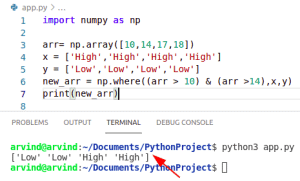 Agreed. Lets take a look at how we can use a matrix with the np.where() function: In the example above, we return a value from the original array if its even otherwise, we return a -1.
Numpy.